

NEW! Lead Hazard Reduction Program
In partnership with U.S. Housing and Urban Development, Southwest Nebraska Public Health Department received funding to provide lead testing and lead hazard reduction services for qualifying families in Southwest Nebraska.
Our certified Lead Hazard Risk Assessors use multiple testing methods to identify lead hazards in and around the home. If hazards are found, SWNPHD will coordinate repairs by trained contractors to help create a safer home environment.
Who Can Qualify?
Homeowners, renters, and landlords may all qualify.
General Requirements
- Home must be built before 1978
- A child under age 6 must live in the home more than 75% of the time
- Household income must be at or below 80% of the county median income
Additional Landlord Requirements
- Proof of ownership
- Intent to continue renting to families
- Both landlord and tenant must agree to participate and meet eligibility requirements
If you think you may qualify, please complete the screening form linked below or contact Melissa Propp at nurse@swhealth.ne.gov for more information or a paper application.

Lead Hazard Reduction Initial Screening Form
Lead Testing
Lead testing is recommended for children 1 to 6 years of age and adults who are exposed to high lead levels through their work such as painters, auto repair workers, galvanizers, plumbers and other professions. Lead exposure can affect nearly every system in the body and symptoms are not always obvious. The effects of lead exposure cannot be corrected.

The most important step parents and daycare providers can take is to prevent lead exposure before it occurs.
- Get the Facts: Find out about the hazards of lead.
- Get Your Home Tested: Find out how to minimize risks of lead exposure by hiring a certified professional to test older homes for lead.
- Get Your Child Tested: A simple blood test can detect lead. Consult your health care provider for advice on testing your children.
Protecting children from exposure to lead is important to lifelong good health. Young children have a tendency to put objects in their mouths, which increases their risk of high lead levels. Even low levels of lead in blood have been shown to affect a child's IQ and the ability to pay attention. Lead exposure has been linked to higher risk of ADHD, especially when combined with exposure to cigarette smoke.
Lead can be found in a variety of sources:
- Lead paint - used widely in homes built before 1950, and not banned from residential use until 1978.
- Water pumped through lead pipes.
- Imported items including clay pots.
- Certain consumer products such as candles, make-up and jewelry.
- Certain imported home remedies.
Be aware of lead in your home:
- If you see paint chips or dust in windowsills or on floors because of peeling paint, clean these areas regularly with a wet cloth.
- Wipe your feet on mats before entering the home, especially if you work in occupations where lead is used. Removing your shoes when you are entering the home is a good practice to control lead.
- Remove recalled toys and toy jewelry from children's access. Stay up-to-date on current recalls by visiting the Consumer Product Safety Commission's web site.
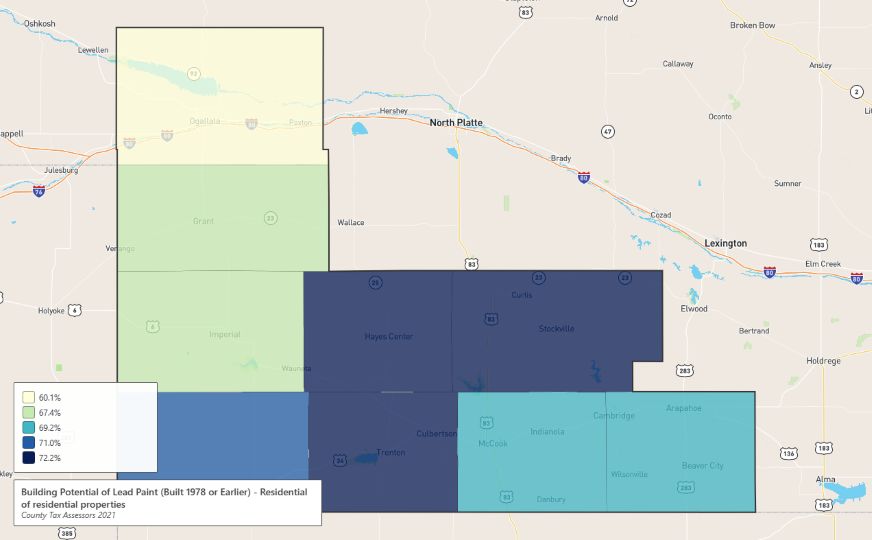
Houses Built 1978 or Earlier
Lead in Nebraska - 2022 Blood Level Surveillance Data
To learn more about preventing lead exposure, visit https://www.cdc.gov/nceh/lead/.